House
A memory palace loses its memory

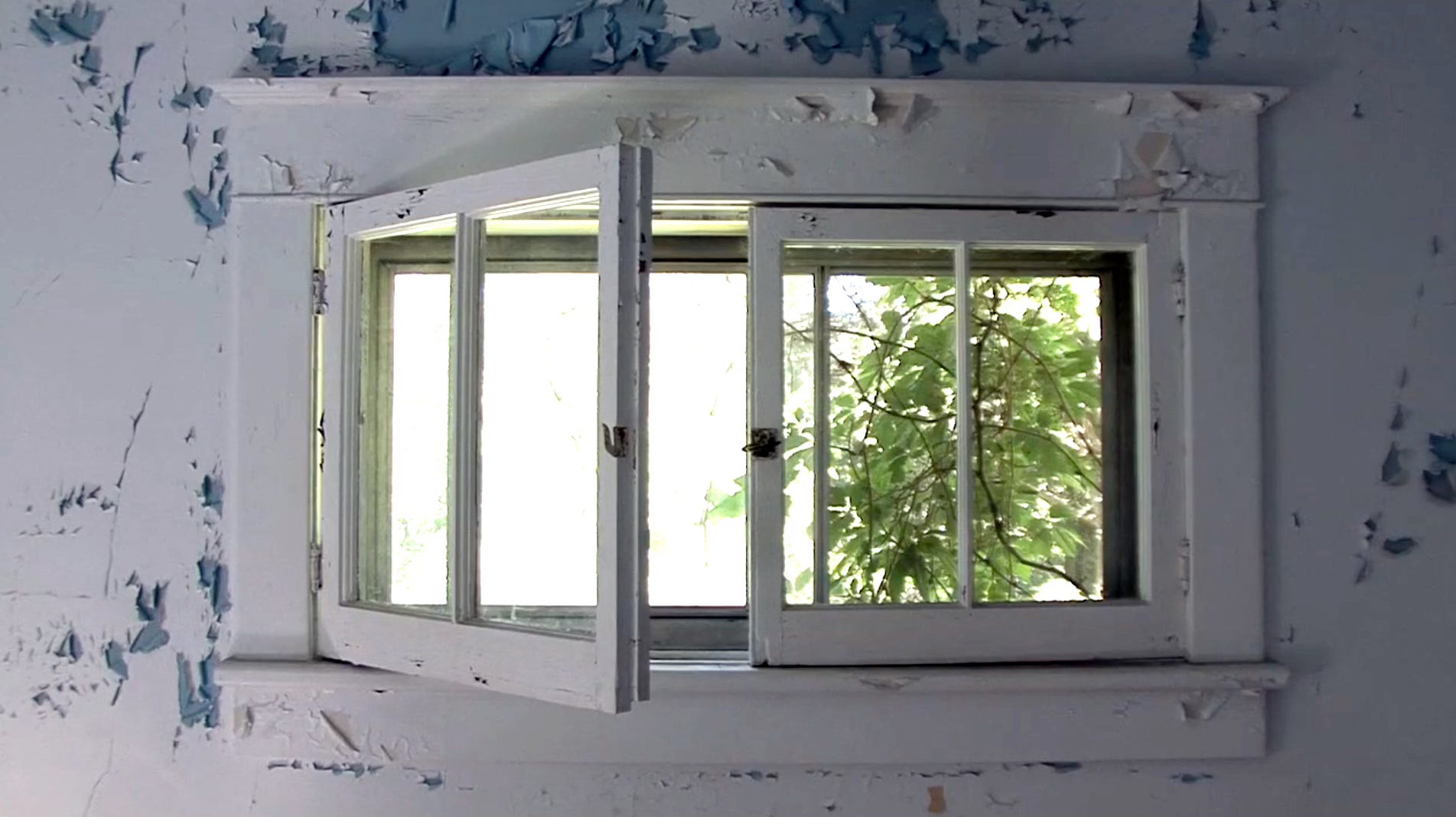
The house is big and white and falling apart. Some windows and doors are covered in plywood; the chimney fell off a few years back—there’s now a boarded-up hole on that side of the house. The garage door is stuck half open. Or half closed, depending on who you ask. Now and then kids break in and do what kids do inside of abandoned houses: drink, mostly, but also vandalize things. Lately though, even they won’t enter the house anymore—the walls are covered in black mold; the ceiling appears to be caving in in some spots. It has been empty for years. The neighbours complain about it periodically, but nothing ever gets done. It should be condemned, but it’s not. It should be torn down, demolished; it should be carted off to a landfill in its entirety. But it sits there still, empty and in a state of slow decay.
When I was a teenager and desperately in love with skateboarding, my family moved from the city to the country. I hated it. I hated it so much. The house was already old then. It smelled old; the wallpaper that covered many of the walls inside was faded and looked as if from another century. I tore the wallpaper off the wall in my bedroom but never painted the walls because I didn’t want to be there. Painting the walls, making the room my own, would have been giving in. I didn’t want to give in. So I lived like that for the years I spent in that house—in a room with unpainted walls, the remnants of the old floral wallpaper still visible in some spots. After I moved out, my sister took over the room and had it painted. Last time I was in there, the paint was peeling off the walls in large sheets; the window was board up. There was a hole in the floor.
But here’s the thing, I drive out there to that house pretty regularly. It’s where I go to think when I’m working on a story. Sometimes I park in the driveway and walk up into the forest behind the house. More often these days, I park down the road and enter the forest from the top of the hill behind the community centre. My wife and I got married on that hill about a hundred years ago. We were supposed to get married in the yard at my family’s house, but, for various reasons, that didn’t happen. We were also supposed to move into that house a couple years later—but, for various reasons, that didn’t happen either.
Despite these negative associations with the house, and despite its state of almost unfathomable disrepair, it is still where I want to go when I’m in a certain mood—not happy, not unhappy, but not neutral either; it’s when I’m in my head in that way I get when I’m writing. Which is most of the time, I guess. (This is why, when people ask if my wife is a writer, I always answer by saying that I’d never marry a writer. We’re the worst. Or I am, anyway.) A certain feeling will come over me when I’m in the middle of working on something, and I’ll know exactly where I need to be. I stop what I’m doing, get in the car, and drive out there. I did exactly this thing a few days ago.
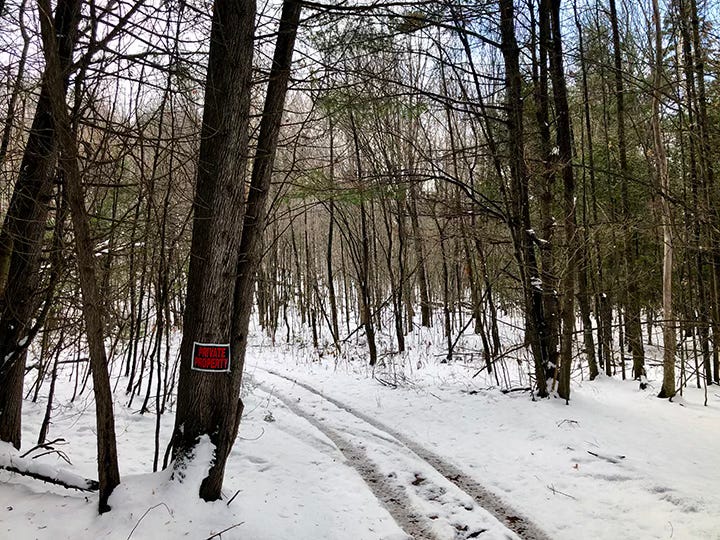
There’s a new private-property sign up on the hill behind the house. My family still owns the place, but the property line stops close to that sign. Someone else owns all the land that extends beyond the hill and deep into the woods. When I was there the other day, I stood far back from the sign and threw snowballs at it. Once I hit the sign—it took three tries—I passed through and into the woods. As a kid, I spent most of my time either in my bedroom reading and listening to records or in that forest. I came to know it very well—I’ve climbed its trees, I’ve sat on its rocks, I’ve chased its rabbits through brambles, I’ve stood among its trees and watched deer pass by so close I could almost touch them. I made my own trails through the snow, sometimes on skis, sometimes stepping through the hard crust of deep snow. Several years ago, I went up there with a video camera and made a short film for a festival that went online that year because of the pandemic. (The story the video was made for will be coming out in my new book—Astrid, Aghast—in February. It’s a story about a complicated familial dynamic. Ahem.)
That was the second time I went up there with a camera. Years earlier, I got a grant to make a film about the house. I wanted to document its decay; I wanted to do this before it either became too dangerous to enter the house or before it finally sank into the earth. I spent days in and around the house with an expensive video camera I barely knew how to use, shooting every room, every wall. There was a beauty in its decay: the faded colours, the way the paint was peeling off the walls, even the pattern of mold on the ceilings and walls. I asked my brother to help with the soundtrack—and he created a beautiful and complicated piece of music to accompany my little film. It ended up playing at some festivals, and when people asked what compelled me to make it, I said that there was, for me, a romance in seeing nature reclaim something that was human-made. That’s part of it. But mostly, I said, I just found a perverse pleasure in seeing the place I hated so much as a kid finally gets its due.
When I was there the other day, I barely looked at the house. I drove past and glanced over at it: still falling apart, still an eyesore, still a hazard. There comes a time when a house you once lived in becomes something else: it either becomes someone else’s house or it gets demolished and it becomes the place where the house you once lived in used to be. This, this is something else. This house has lost most of its memories, as far as I can tell. It has stopped being what it was and is now in some liminal space. Can houses inhabit the bardo? If such a thing is possible, that’s where this house is. Someday it will be gone, but for now it sits there—a complicated mess of wood and glass, almost but not quite divorced from its original purpose.
I loved this; My favourite sentence, "When I was there the other day, I stood far back from the sign and threw snowballs at it.
I do it every time!